
💡 Edge & Compounding
LESSON 1: WHAT IS AN EDGE?
An “edge” is the reason a trader can make money over time.
It is a repeatable advantage — something that shifts the probabilities slightly in your favor over a large sample of trades.
Without an edge, trading becomes random guessing.
A single winning trade does NOT prove someone has an edge. Even bad traders can make money temporarily, and even random entries can work sometimes.
A real edge only becomes visible over time.
What Actually Creates an Edge?
Most trading edges come from a combination of things working together:
* A repeatable setup
* Proper risk management
* Good execution
* Emotional discipline
* Consistency
It is usually not one magical indicator or secret strategy.
For example, an edge may come from consistently:
* Trading with trend
* Respecting risk
* Cutting losses quickly
* Letting winners work
* Avoiding emotional trades
Small advantages may not seem powerful trade-by-trade, but over time they can compound significantly.
Most Traders Focus on the Wrong Thing
Many beginner traders spend their time searching for:
* The perfect indicator
* A secret strategy
* Guaranteed setups
* Extremely high win rates
That usually leads to constantly changing systems and trading emotionally.
In reality, most profitable traders are doing relatively simple things consistently and managing risk properly.
The hard part is usually not finding an edge.
The hard part is executing it consistently over time.
.
An Edge Does NOT Mean Every Trade Wins
This is one of the biggest misconceptions in trading.
A trader with a real edge will still:
* Have losing trades
* Have red days
* Experience drawdowns
* Be wrong regularly
Trading is a probability game, not a certainty game.
The goal is not perfection.
The goal is that over many trades, the winners outweigh the losers.
Why Tracking Performance Matters
This is one reason we track every alert in 🏆discord-performance.
Over time, data helps reveal:
* Which setups actually perform well
* Which market conditions work best
* Average reward-to-risk
* Win rates
* Expectancy
Without tracking performance, traders often rely too heavily on emotions and memory instead of real statistics.
Final Thought
A real edge is not about predicting every move correctly.
It is about having a repeatable process that produces positive results over time.
The market will always involve uncertainty.
An edge simply shifts the probabilities slightly in your favor — and with discipline, consistency, and proper risk management, even a small edge can compound into meaningful long-term results
LESSON 2: WHY WIN RATE ALONE DOESN’T PAY
One of the biggest beginner misconceptions in trading is believing that a high win rate automatically means profitability.
It does not.
A trader can win most of their trades and still lose money overall.
At the same time, a trader can be wrong frequently and still become consistently profitable.
Win Rate Without Risk Management Means Very Little
Imagine two traders.
Trader A wins 80% of the time.
Sounds amazing.
But every losing trade is huge because they:
* Hold losers too long
* Oversize emotionally
* Refuse to stop out
Meanwhile their winners are small because they take profits too quickly.
Despite winning most trades, the account slowly bleeds over time.
Now imagine Trader B.
Trader B only wins 50-60% of the time, but:
* Keeps losses controlled
* Lets strong trades reach T1 and T2
* Maintains good reward-to-risk
* Trades consistently
Trader B often becomes far more profitable long term despite a lower win rate.
Why Beginners Chase High Win Rates
A lot of traders become emotionally attached to “being right.”
That usually leads to:
* Cutting winners early
* Refusing losses
* Averaging down emotionally
* Avoiding stop losses
* Taking tiny profits just to increase win percentage
The problem is that one large uncontrolled loss can erase dozens of small wins.
Trading is not about winning the most trades.
It is about making more on winners than you lose on losers over time.
.
A 90% Win Rate Can Still Lose Money
This surprises many people at first.
If a trader:
* Makes $50 on winners
* But loses $500 on losers
…they can still lose money even with a very high win rate.
That is why professional traders focus heavily on:
* Risk management
* Position sizing
* Reward-to-risk
* Expectancy
Not just accuracy.
The Goal Is Positive Expectancy
The real goal in trading is not:
“How often am I right?”
The real goal is:
“Does my system make money over many trades?”
That depends on the relationship between:
* Win rate
* Average winner
* Average loser
* Risk management
This is called expectancy, which we’ll cover in the next lesson.
Final Thought
A high win rate may feel good emotionally, but emotions do not determine profitability.
Good trading is not about avoiding losses completely.
It is about keeping losses controlled while allowing winners to outweigh them over time.
That is what creates sustainable long-term results.
LESSON 3: EXPECTANCY — YOUR REAL MATH
Expectancy is one of the most important concepts in trading because it measures whether your system actually makes money over time.
This is the real math behind an edge.
A lot of traders focus only on:
* Win rate
* Individual trades
* Daily P&L
But expectancy looks at the bigger picture.
What Is Expectancy?
Expectancy measures the average amount a trader can expect to make or lose per trade over a large sample size.
In simple terms:
If you repeated the same setup hundreds of times, would you expect to make money overall?
A positive expectancy means your edge is profitable over time.
A negative expectancy means the system loses money over time.
Expectancy = Expected Value
Another way to think about expectancy is expected value.
Expected value asks:
“If I took this same type of trade over and over again, what would I expect to make on average per trade?”
That average may be:
* Positive
* Negative
* Or breakeven
The goal in trading is not to guarantee any single trade wins.
The goal is to consistently execute trades with positive expected value over a large sample size.
What Creates Expectancy?
Expectancy is built from:
* Win rate
* Average winner
* Average loser
* Risk management
* Consistency of execution
This is why two traders with the exact same win rate can have completely different results.
One trader may:
* Cut winners early
* Let losers grow
* Trade emotionally
While another trader:
* Lets strong trades reach targets
* Keeps losses controlled
* Follows structure consistently
Same win rate.
Very different expectancy.
.
A Simple Example
Imagine a trader who:
* Wins 50% of trades
* Makes 2R on winners
* Loses 1R on losers
Over 10 trades:
* 5 winners = +10R
* 5 losers = -5R
Net result:
+5R overall
Even though the trader was only right half the time, the expectancy is still positive because the winners outweighed the losers.
That works out to +0.5R per trade on average. That is the expectancy.
The Formula
Expectancy = (Win Rate × Avg Winner) − (Loss Rate × Avg Loser)
In our example: (0.5 × 2R) − (0.5 × 1R) = +0.5R per trade
Small Edges Compound Over Time
One important thing to understand:
An edge does not need to be massive.
Even a relatively small positive expectancy becomes powerful over time if:
* Risk stays controlled
* Position sizing stays consistent
* Emotional mistakes stay limited
* The trader keeps executing the system properly
Most professional trading is not about huge home runs every day.
It is about repeatedly applying a positive edge over many trades.
Real Data Matters
This is why tracking performance matters so much.
Over time, statistics help reveal:
* Average R per trade
* Which setups perform best
* Which market conditions work best
* Whether expectancy is improving or weakening
Without data, traders often rely too much on emotions and short-term results.
What's Considered a Good Expectancy?
A common question after learning expectancy is: "what number is actually good?"
Here is a rough guide based on professional trading benchmarks (sustained across 50-100+ trades):
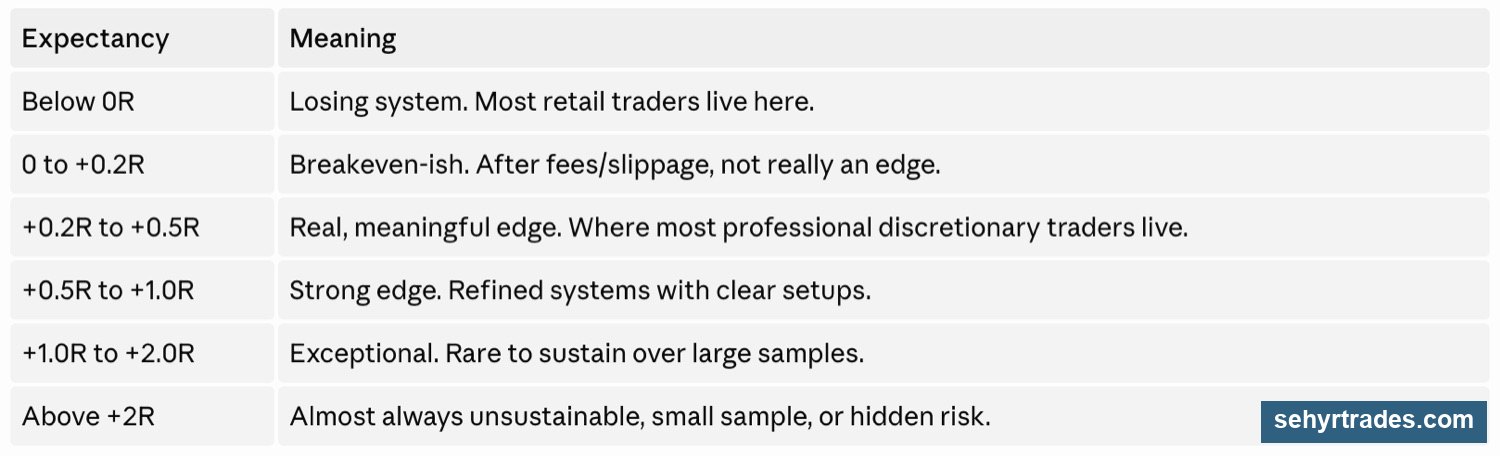
If your system doesn't have a fixed R per trade
Some traders measure expectancy in % per trade instead of R — this is common when trades have varying stop sizes (like raw broker trades without consistent risk rules).
Here's the equivalent scale:
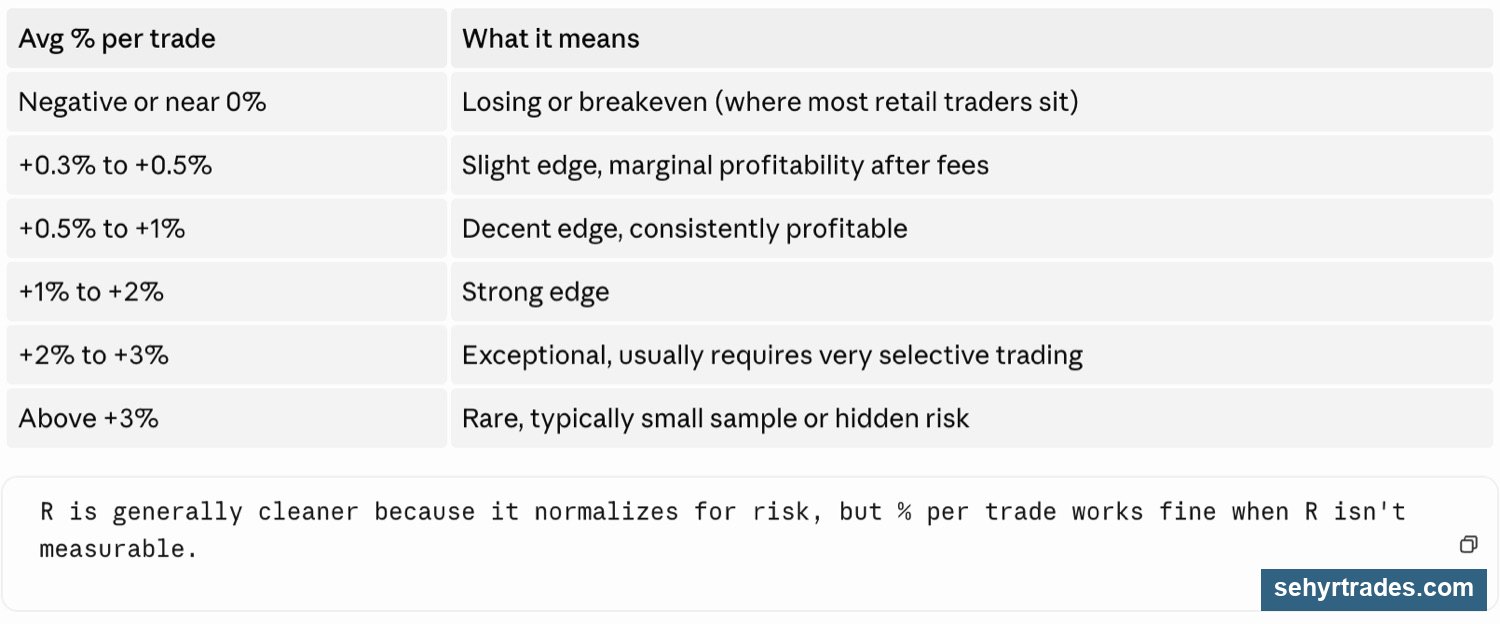
Three big caveats:
Sample size matters most.
+1R over 20 trades is noise. +0.4R over 300 trades is real edge. Anything under ~50 closed trades shouldn't be trusted.
Frequency matters too.
+0.5R per trade with 200 trades a year compounds way faster than +0.5R per trade with 20 trades a year.
Bigger expectancy usually means bigger drawdowns.
Systems with +1R or higher tend to have wider stops or longer holding periods that test patience.
Most beginners chase huge expectancy and lose because they take on too much risk. Most professionals are content with a smaller, repeatable edge that compounds reliably over time.
Final Thought
Individual trades mean very little by themselves.
Good trading is about probabilities over a large sample size.
Expectancy is what determines whether a strategy actually works long term.
A trader with discipline, proper risk management, and positive expectancy does not need to win every trade.
They simply need to consistently execute an edge that produces positive results over time.
LESSON 4: HOW POSITION SIZING MULTIPLIES YOUR EDGE
An edge by itself is not enough.
How you size your positions determines how much that edge actually matters over time.
Two traders can trade the exact same strategy with the exact same expectancy and still end up with completely different results depending on risk management and position sizing.
📌 Edge × Position Sizing = Trajectory
Think of expectancy as the engine.
Position sizing determines how much power actually reaches the account.
A trader with:
* Good expectancy
* Consistent risk
* Emotional discipline
…can compound steadily over time.
But a trader with the same edge who:
* Oversizes emotionally
* Changes risk constantly
* Revenge trades
* Takes random all-in positions
…often destroys their own expectancy.
The edge may still exist, but poor sizing overwhelms it.
📉 Why Consistency Matters
One of the biggest mistakes traders make is changing risk based on emotion.
For example:
* Oversizing after a winning streak
* Increasing size to “make money back”
* Taking huge risk on a setup that “feels guaranteed”
That inconsistency damages long-term compounding.
Professional traders usually risk very consistently because consistency allows expectancy to play out properly over large samples.
This connects directly back to the 1% rule from the Risk & Execution section.
📊 Small Edges Become Powerful With Consistent Risk
A trader does NOT need massive gains on every trade.
For example:
If a trader:
* Risks 1% per trade
* Maintains positive expectancy
* Executes consistently
* Avoids catastrophic losses
…the account can compound steadily over time.
Most long-term success in trading comes from:
* Repetition
* Consistency
* Survivability
Not random huge wins.
⚠️ Oversizing Distorts Everything
When traders risk too much:
* Emotions increase
* Execution worsens
* Discipline breaks down
* Drawdowns become harder to recover from
Even a profitable system can fail if position sizing becomes reckless.
A trader risking:
* 1% consistently
behaves very differently psychologically than a trader risking:
* 10-20% emotionally
The larger the risk, the harder consistency becomes.
Same Edge, Different Outcomes — A Quick Example
Two traders both have a +0.5R expectancy. After a normal 5-trade losing streak:
- Trader A risks 1% per trade → drawdown is -5% (easy to recover)
- Trader B risks 5% per trade → drawdown is -25% (career-ending for many)
Same expectancy. Same losing streak. Trader B's bigger sizing did not multiply the edge — it amplified the drawdown to the point of psychological breakdown.
That is what oversizing actually does to an edge over time.
💡 The Goal Is Controlled Growth
A lot of beginner traders focus entirely on:
“How fast can I grow the account?”
Professional traders think more about:
“How long can I preserve and compound this edge?”
Fast growth usually comes with:
* Larger drawdowns
* Higher emotional pressure
* Greater instability
Controlled growth tends to survive much longer.
📈 Final Thought
An edge only matters if a trader survives long enough to let it compound.
Position sizing is what allows a positive expectancy to actually scale over time without emotional decision making destroying the process.
Small consistent edges combined with disciplined risk management become surprisingly powerful over large samples of trades.
.
LESSON 5: COMPOUNDING — WHY SMALL WINS BECOME BIG
One of the most powerful concepts in trading is compounding.
Compounding happens when profits begin generating additional profits over time.
Instead of staying the same size forever, the account slowly grows — which allows position sizes, dollar gains, and overall growth potential to increase as well.
📌 Small Edges Add Up
A lot of beginner traders underestimate how powerful consistency can become over long periods of time.
They often focus on:
* Huge wins
* Fast money
* “All-in” trades
* Trying to double accounts quickly
But most sustainable trading growth comes from repeatedly stacking smaller gains while controlling risk.
For example:
A trader who:
* Maintains positive expectancy
* Risks consistently
* Protects capital
* Avoids catastrophic losses
…can slowly build momentum over hundreds of trades.
The key is that the account survives long enough for the math to start working.
📈 Compounding Starts Slowly
One reason many traders quit early is because compounding feels small at first.
At the beginning:
* Gains may look modest
* Progress may feel slow
* The account may not seem to move much
But over time, growth begins building on previous growth.
That is where compounding becomes powerful.
The process is usually:
* Slow at first
* Then gradually accelerates
* Then becomes much more noticeable later
⚠️ Most Traders Interrupt Their Own Compounding
Compounding only works if the trader stays consistent.
Many traders destroy compounding by:
* Oversizing emotionally
* Revenge trading
* Taking huge drawdowns
* Constantly changing systems
* Chasing unrealistic returns
One major loss can undo months of steady progress.
That is why protecting capital matters so much.
📊 Compounding Is More About Survival Than Speed
A lot of social media trading content focuses on:
* Turning small accounts into huge accounts instantly
* Massive percentage gains
* Extreme leverage
What usually gets ignored is survivability.
Professional traders think much more about:
* Staying consistent
* Protecting capital
* Preserving expectancy
* Avoiding catastrophic drawdowns
The goal is not explosive short-term growth.
The goal is sustainable long-term growth.
💡 Why Risk Management Matters So Much
Compounding works best when:
* Risk stays controlled
* Position sizing stays disciplined
* Drawdowns remain manageable
* The trader keeps executing consistently
Small consistent gains compounded over years become far more powerful than occasional huge wins mixed with catastrophic losses.
📈 Final Thought
Compounding is not magic.
It is the result of:
* Positive expectancy
* Consistent execution
* Controlled risk
* Patience over long periods of time
Most traders fail because they try to rush the process.
The traders who survive long enough for compounding to fully work are often the ones who eventually become consistently successful.
LESSON 7: WHAT DESTROYS COMPOUNDING
Compounding is powerful, but it is also fragile.
A trader can spend months building steady growth and then destroy a huge portion of it in a few emotional decisions.
That is why long-term success in trading is usually less about finding new setups and more about protecting the edge you already have.
📉 Oversizing Destroys Compounding Fast
One oversized trade can do massive damage to long-term growth.
For example:
* A trader compounds steadily for months
* Confidence grows
* Then they suddenly risk 10-20% on one trade that “looks guaranteed”
If that trade fails, the drawdown can erase months of disciplined progress almost instantly.
The problem is not just the money loss.
Large drawdowns also create:
* Fear
* Hesitation
* Revenge trading
* Emotional instability
That psychological damage often hurts future performance too.
📌 Big Drawdowns Become Harder to Recover From
A lot of traders underestimate how damaging large losses are mathematically.
For example:
* A 10% drawdown needs about 11% to recover
* A 25% drawdown needs about 33%
* A 50% drawdown needs 100%
The deeper the drawdown, the harder recovery becomes.
This is why protecting capital matters so much more than chasing huge short-term gains.
⚠️ Emotional Trading Interrupts the Process
Compounding only works if the trader stays consistent long enough for the edge to play out.
Emotional mistakes interrupt that process.
Common examples:
* Revenge trading after losses
* Chasing momentum emotionally
* Cancelling stop losses
* Constantly switching systems
* Taking random trades outside the plan
* Trading out of boredom
Most traders do not lose because their edge completely disappears.
They lose because discipline disappears.
📊 Consistency Matters More Than Intensity
Many traders approach trading with extreme intensity:
Huge size
Huge emotions
Huge expectations
Then they burn out quickly.
Long-term compounding usually comes from:
Controlled risk
Smaller repeatable decisions
Emotional stability
Consistency over years
Professional trading often looks much more boring than social media makes it seem.
💡 Protecting the Edge Matters More Than Finding New Ones
Once a trader has:
Positive expectancy
Consistent execution
Controlled risk
…the main goal becomes protecting that process.
A smaller edge applied consistently for years is usually far more powerful than constantly chasing “better” strategies while trading emotionally.
📈 Final Thought
Compounding is not destroyed by one bad trade alone.
It is usually destroyed by the emotional decisions that follow:
Oversizing
Revenge trading
Ignoring risk
Breaking discipline
The traders who compound successfully long term are usually not the most emotional or aggressive traders.
They are the traders who protect their edge consistently over very large samples of trades.
LESSON 8: THE LONG-TERM MINDSET
One of the biggest reasons traders fail is because they underestimate how long consistency actually takes.
Most people enter trading wanting:
* Fast money
* Immediate freedom
* Quick results
* Constant winning
But real trading development usually happens much slower than people expect.
📉 Most Traders Quit Before the Edge Fully Plays Out
A trader may:
* Have positive expectancy
* Be improving steadily
* Be building discipline
* Be developing consistency
…but still feel frustrated because the progress feels slow at first.
This is where many traders quit.
They:
* Change systems too quickly
* Chase new strategies
* Oversize trying to speed things up
* Or abandon the process entirely
Compounding requires time.
Most people never stay consistent long enough to fully experience it.
📌 Trading Is a Long-Term Skill
Good trading is not built in:
* A week
* A month
* Or even a few good trades
It is built through:
* Repetition
* Pattern recognition
* Emotional control
* Risk management
* Experience across different market conditions
There are no shortcuts around screen time and discipline.
📊 Progress Often Feels Invisible At First
One difficult part of trading is that improvement is often happening before the results fully show up financially.
For example:
* A trader stops revenge trading
* Position sizing improves
* Losses become smaller
* Entries become cleaner
* Discipline improves
Those changes may not immediately create massive profits, but they are building the foundation for long-term consistency.
A lot of trading growth is invisible before it becomes obvious.
⚠️ Comparing Yourself To Others Is Dangerous
Social media often creates unrealistic expectations.
People mostly post:
* Huge wins
* Perfect trades
* Big account screenshots
* Fast success stories
What usually gets hidden:
* Drawdowns
* Losing streaks
* Emotional struggles
* Years of inconsistency
* Failed accounts
Comparing your real journey to someone else’s highlight reel usually creates frustration and emotional trading.
💡 The Goal Is Longevity
A trader who survives and improves steadily for years often ends up far ahead of traders chasing fast results emotionally.
Long-term traders focus on:
* Protecting capital
* Preserving mental clarity
* Staying disciplined
* Improving gradually
* Letting compounding work over time
The goal is not proving yourself in one trade or one month.
The goal is building a repeatable process that can survive for years.
📈 Final Thought
Trading is not a sprint.
It is a long-term process of developing:
* Skill
* Discipline
* Emotional control
* Risk management
* Consistency
Most people fail because they try to rush the process.
The traders who stay patient, protect their edge, and continue improving over time are usually the ones who eventually separate themselves long term.
Trade it with us.
Inside the room you get the live day and swing alerts with the exact entry, stop and targets, a daily watchlist, the halal scanners and the trade reviews.
Join premiumSehyr Trades is an educational community. Nothing here is financial advice, a recommendation, or a solicitation to buy or sell any security. Trading involves risk, including loss of capital. Always do your own research.